Skip to content

The Insight Collective

Principles for AI integration

These principles guide how the Insight Collective examines AI initiatives. They are intended to improve decisions, expose dependencies, and keep technical possibility connected to organizational reality.

Ten principles

  1. Start with the outcome and the decision

    Technology follows the problem being solved.

  2. Treat AI integration as a connected system

    Technology, work, organization, and people affect one another.

  3. Examine work as it actually happens

    Formal process maps rarely capture exceptions, workarounds, incentives, or hidden dependencies.

  4. Respect expertise without treating existing practice as untouchable

    Domain experts must shape the system and retain the authority to question it.

  5. Use AI selectively

    Capability does not establish usefulness, safety, or value.

  6. Redesign the work before training people on it

    Training cannot repair a defective operating model or poorly designed implementation.

  7. Measure before scaling

    Adoption, speed, and activity are weak substitutes for business outcomes, trust, quality, and risk.

  8. Treat integration as an ongoing operating capability

    AI systems, organizations, and the conditions surrounding them continue to change.

  9. Reject single-cause explanations

    AI failures usually cross organizational, workforce, process, data, and technical boundaries.

  10. Preserve human challenge and accountability

    People affected by an AI system need practical ways to question its output and surface consequences.

Three dimensions

AI integration cannot be understood through any one of these alone. Each is examined against the other two.

  • Organization

    AI inherits the incentives, structural divisions, information barriers, ownership conflicts, and operating weaknesses of the organization deploying it. Faster technology can accelerate those weaknesses rather than resolve them.

    What we examine

    • Which outcome is the organization actually trying to change?
    • Who benefits, who carries the risk, and who can stop the system?
    • Where do incentives or organizational boundaries work against the intended result?
    • What happens when the AI crosses functions, vendors, or lines of authority?
  • Workforce

    Adoption is not a communications problem or a prompt-training problem. People interpret AI through their experience of the work, their trust in leadership, the consequences of errors, and their ability to challenge decisions.

    What we examine

    • How does the system change work, judgment, expertise, and status?
    • Where are employees compensating for weaknesses the formal process does not acknowledge?
    • Can people question an AI output without being treated as the source of the problem?
    • Does the implementation strengthen capability or create dependence and disengagement?
  • Technology

    Models are only one part of the implementation. Data, integration, workflow design, controls, exceptions, observability, and operating support determine whether an AI capability can produce dependable results.

    What we examine

    • Is AI appropriate for this task and consequence level?
    • What evidence supports the expected accuracy and business value?
    • How will exceptions, failures, drift, and human escalation be handled?
    • Does the organization have the data, tools, integration, and operational support to sustain it?

These questions in conversation

The podcast →
No. 0020:29:09

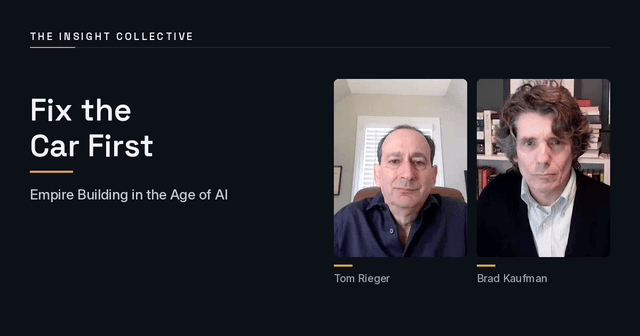
Fix the Car First

Tom Rieger and Brad Kaufman

Tom Rieger and Brad Kaufman on what AI does to an organization that already has silos: it does not fix the dysfunction, it makes it faster. Decision rights, source-of-truth data, and the unwritten rules nobody remembers making.

  • Artificial Intelligence
  • Leadership
  • Business
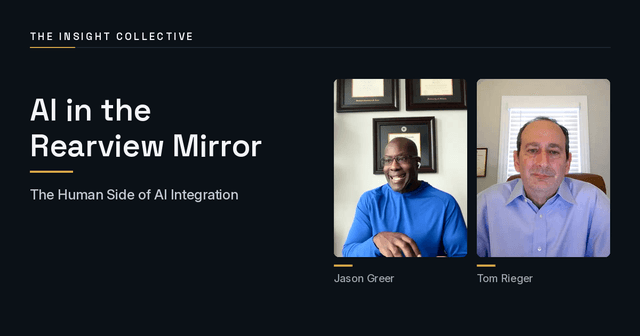
No. 0010:30:42

AI in the Rearview Mirror

Jason Greer and Tom Rieger

Jason Greer and Tom Rieger on why AI systems, trained entirely on past data, are always looking in the rear view mirror — and why successful AI integration turns out to be an organizational and human problem more than a technical one.

  • Artificial Intelligence
  • Leadership
  • Business

Where is your AI initiative breaking down?

The Collective works with leaders responsible for AI value, operational performance, workforce impact, or program risk. We are most useful when an initiative looks technically plausible but remains difficult to adopt, scale, govern, or trust.

Discuss an AI initiative