AI in the Rearview Mirror
The Human Side of AI Integration
Watch and listen

- Jason Greer
- Tom Rieger
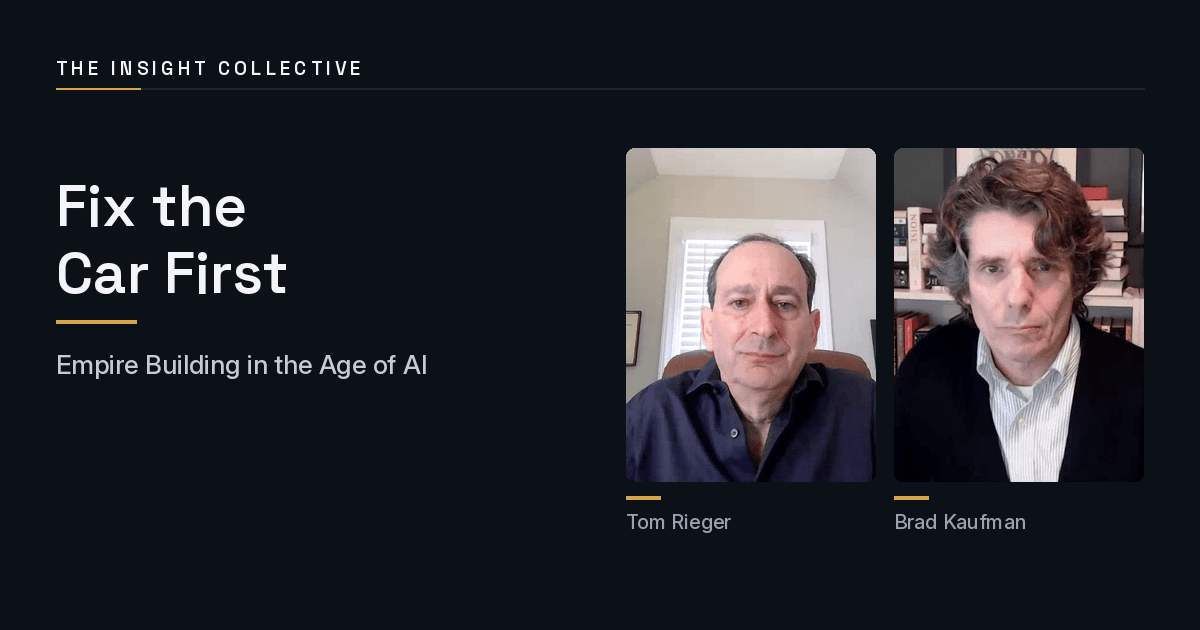
Jason Greer and Tom Rieger on why AI systems, trained entirely on past data, are always looking in the rear view mirror — and why successful AI integration turns out to be an organizational and human problem more than a technical one.
- Artificial Intelligence
- Leadership
- Business
Jason Greer and Tom Rieger open the show with a problem that has nothing to do with model quality: AI systems are trained on past data, so by definition they are always looking in the rear view mirror.
Tom opens with a joke about marketing staff and software engineers on a train, where a tactic that worked once gets copied by a team that never understood why it worked. From there the conversation turns to how quickly the ground can move — COVID as the extreme case, and Skype losing to Zoom despite being positioned to win.
The rest is about people. Tom cites research the two of them worked on, where organizations that integrated AI well saw market cap gains while those that did not saw comparable drops — and the deciding factors were organizational rather than technical. Jason brings what employees tell him directly: that AI arrives as one more threat to a job already under pressure, from an employer who may not understand the technology either.
They discuss Babylon Health's doctors being ostracized for raising concerns, Klarna's assumption that agents could simply replace reps, and why automating only the easy contacts makes everything left over harder. Both keep returning to the same requirement — a human in the loop with enough standing to say an assumption no longer holds.
The closing advice: don't be afraid of moving fast, but keep your eyes open, and make sure your system isn't only looking behind you.
Jason Greer
0:00Hey, Tom, it's such a pleasure to be here with you. You and I have had numerous conversations about artificial intelligence, both the pros, the cons, the things we agree on, the things we kind of wonder what else is out there, right?
Tom Rieger
0:12Right, yep, yep.
Jason Greer
0:13And you know, one of the things that you and I have really talked a lot about is the importance of not over relying on the history of how your organization has always done things because that in itself can be a roadblock to your successful integration of artificial intelligence in terms of integrating with the employees, getting employee buy-in, as well as the growth of your organization. Does that sound fair?
Tom Rieger
0:38Yeah, that's all very true. And if you over-rely on the history, you are definitely heading down a dangerous path. And let me illustrate that with a story I'm gonna steal from a colleague I heard a couple of years ago. So there is a group of marketing guys and a group of AI software engineers that had to go to a conference from Washington to New York. So they all go down to, you know, Union Station, and each of the AI engineers buy a ticket. And the marketing guys between them, there were six of them, they only buy one ticket. And the software engineers are going, dudes, yeah, well, what are you doing? You're gonna get kicked off the train. They're like, don't worry about it. And there's like, all right, well, you know, your funeral. So they get on the train and they see a conductor, one car up and the entire marketing team gets up and goes into the bathroom and shuts the door. And the conductor comes down, knocks on the door and says, ticket please. And one hand comes out holding the ticket. And the software engineers are furious. They're like, we can't let them get away with that. Right, so that was the past that they used then to train their model. So, you know, in the evening in the hotel, they're like running through scenarios. they created some workflows and everything and ran everything and then they found a vulnerability. They said that assumed that the restroom was empty. And so what we're going to do is we'll wait till the conductor's two cars up, we could see through the window and then we'll go and take the bathroom and then they'll get caught for sure. So conference is over, they go back to Grand Central Station to buy a ticket home and the AI software engineers together buy only one ticket and they're kind of snickering to each other. And they said, okay, marketing guys, go ahead, buy your one ticket. They're like, we don't need one. I'm like, what? They said that we don't need one, don't worry about it. They're like, well, okay. And then so they get on the train and they're all like ready to go. And then they see the conductor, two cars up. So they were all racing in the bathroom, shut the door. A minute later, one of the marketing guys goes up, knocks on the bathroom door and says, ticket please. So, you can see the danger here, right? You had a situation in the past that lets one outcome and then everything changed. Now, you may say, but what does that have to do with how business change and the pace of business? Think about COVID, right? As one extreme example, you know, you had, no one predicted that, right? You had 60% of small businesses close and never reopen. One out of five dental practices closed during that time. Airlines, half their revenue gone. Hotels, half their revenue gone. The video game industry, however, skyrocketed, right? Because people couldn't leave their homes. Good luck buying vacation property. That skyrocketed. Home office equipment skyrocketed. So there were winners and losers, but no one could see that coming. And then guess what? When people could go outside again, a lot of that changed back. So, if you rely too much on the past, without that human in the loop questioning assumptions and checking things along the way, then it's dangerous. But as I'm sure you've seen, questioning those assumptions could be dangerous. Well, very much so.
Jason Greer
3:57I always use the example of if you want to look at a business that was positioned for the future but wasn't positioned for the future, you look at Skype, right? Because Skype is something that, Skype is a system that if anything should have exploded during COVID, but no one really talks about Skype because Zoom came through, because if you notice with Zoom's business model, Zoom was consistently adapting to the needs of the people in real time, right?
Tom Rieger
4:23Right, right, yeah.
Jason Greer
4:25Whereas Skype was still utilizing a business model that was rooted in whatever year it was founded, but it was not ready, systemically, it was not ready for the influx of people who all of a sudden had to do videos virtually, right? who were working from home were Zoom adapted, right?
Tom Rieger
4:43Into it, yeah. So Skype was always looking in the rear view mirror. Exactly. And Zoom was looking forward. And if you think about, by definition, AI systems are trained on past data. They're always looking in the rear view mirror and basing the future on that. Some, you know, some, I guess, could do some extrapolating, but again, without that human in the loop. And from what I've seen is If the AI system, if things start to change and there isn't that human in the loop saying that this assumption is no longer valid, we got to retrain, the AI system is assumed to be right until proven wrong because it's going fast, right? Yes. On the other hand, I as an employee, if I'm questioning things, I'm assumed to be wrong until proven right and so am I going to
Jason Greer
5:32speak up or what do you think would happen in that scenario? Well, see, and here's another of it especially when you look at the history of how things have always been done if I'm an employee and I go to speak up if I don't know that the marker to speak up has changed right when I should speak up but more importantly who and where I should speak up to right if those things have changed but I have not kept up with that change or the community or the organization's not done an effective job of communicating what that looks like or both then essentially what you're creating is chaos before you would know chaos is coming. Absolutely. That's a great point. Great point.
Tom Rieger
6:09And a good example of that, if you look at the Babylon health example, when the diagnosing chat bot was starting to show some cracks, doctors spoke up. And from what I understand, they were attacked. They were ostracized. And instead of everything's pausing and saying, okay, wait a minute, let's take this beat back and adjust. It was no, that, you know, just don't, don't rock the boat and that's so dangerous. Yeah.
Jason Greer
6:37It's very dangerous, but it also, there was a certain point, I think, where we've accepted, we've accepted that ChatGPT, Claude, Gemini, whatever the case might be, is just right and human beings are just wrong. Right? Right. Yeah. And I'll never forget the story of the student that had been using Gemini for all of his term papers. And he thought that he was going to get an A and what he didn't recognize is that his professor was just taking his papers, taking his papers, taking his papers. And all of a sudden the kid ends up with an F. He's like, how did I end up with an F? He goes, did you ever consider that what Gemini was putting out was actually factually wrong?
Tom Rieger
7:21No, that's the problem. Exactly. That's just assumed to be right. I even find myself when I'm doing something and I run it through and it says, well, no, that's not quite right. I was like, oh, my first instinct is, oh, thank you, Claude, or whoever, you caught a mistake. And sometimes, yeah, it has, or it's just a better way of doing things. Other times, uh-uh, I've found cases where, no, I was actually right to begin with. but it just stresses the importance of maintaining that human in the loop. The AI and the human should be a partnership, right? It shouldn't be the human is now working for the AI agent, or even worse, you use the AI to just get rid of all the people and then there's no one left to question the assumptions.
Jason Greer
8:05Right, so I guess my question to you, Tom, is what do you do next? I mean, you consider, I heard this the other day in a podcast that Anthropic AI, I think in its first year did about a billion dollars. Now Anthropic AI is on the verge of doing about $60 billion for this upcoming year. And it continues to grow and it continues to grow, it continues to grow, which obviously that means that people are utilizing these services. So you're an organization that, let's say you're using Anthropic, let's say you're using whatever. How do you successfully get, it's one thing to purchase it, but how do you then integrate it into your environment?
Tom Rieger
8:47That I think is the key question that not enough organizations are asking, especially the last part of what you said, is how do you integrate it in your environment? The technology is great, and if you use it right, it is a complete force multiplier, right? It could free up people to get out of some of the more routine parts of the job and really focus on some of the value adds. it can greatly improve efficiency. No, we did a study, if you recall, when you and I were looking at financials even, those who did it right saw increases in market cap of up to 40%, increases in that but up to 25%. Those who didn't saw equal size drops. So that's an 80% swing in market cap. And the factors that you have to get right to do that integration properly weren't necessarily the tech. It was, is your organizational ecosystem structured in a way to be able to take advantage of that and have you thought about your human assets and how they're gonna fit in and your customers, their human beings too, your board members. Have you taken into account all those human elements and all those organizational elements and make sure your organization's ready? If you have dysfunction, if you have interdepartmental conflict, if you have information hoarding, those things could derail
Jason Greer
10:12the entire initiative. A hundred percent. You know, one of the things that I hear from employees, and you know, I always appreciate that we sort of have the quantitative side and the qualitative side, right? Yeah, I'm a blockhead, but yeah, that's me. And I'm the qualitative guy that I sit down with a group of employees and be like, tell me your life story, and we'll talk three hours, right? But one of the things that I consistently hear from employees is I'm already fighting, prior to AI I was already fighting market conditions that were potentially causing, could cause a layoff, could cause me to have my jobs complete, my job completely terminated. Now you add AI to the mix and it looks like my employer is bringing in something that I don't understand but my employer is saying that that thing that I don't understand, I'm not sure the employer understands it, can do my job 10 times faster than I can even think. Why would I embrace something that's going to ultimately be a job killer for me?
Tom Rieger
11:15Right, right, and in that situation, that's a legitimate question. And if you look at what Klarna did, everyone knows the Klarna story, they made the assumption, There are agents, there are AI agents in all cases can simply replace the reps. And it works for some things. What if you had a really upset caller? You know, and the AI is, you know, it's the roboticness and, you know, cheerfulness and etc. and you're ready to strangle somebody, you know, you want someone to empathize with you. So there are certain things that it's not necessarily good for. You know, I've done a fair amount of call center work over the years, and it is a very legitimate thing to try to automate some of the interactions because it saves a lot of money, it speeds things up, and in a lot of cases, it's fine, right? It avoids the wait. But the only things you could really effectively automate are the easy contacts, the easy ones. There are still difficult ones. And what ends up happening is your average handle time, because the only thing getting to the reps are the tougher things goes way up, way. And so the cost per handling each contact is not going to stay where it was, it's going to get worse. And so I think people don't always understand that when you automate one thing, that it increases a burden on something else. Yes, unless you can automate your entire organization, but then you come, you get vulnerable to the history part that we talked about. No one's questioning things. No one's questioning the assumptions. No one's jumping in and saying, wait a minute, this doesn't fit. We got to pull this out of this workflow and handle it differently.
Jason Greer
13:02Yeah, and also the other side of it is, I don't know that I always trust AI to tell me the truth, right? Because that's another situation. I have a client that's going through that very thing. They trusted that AI system to effectively tell them the truth based on the data that they inputted and they start making business decisions based on what the AI system was telling them and it turned out that the AI system was completely wrong. Now this wasn't just a case of well it's wrong therefore I should have bought cupcakes for the employee you know the employee. This cost this cost me millions of dollars right and it cost me a bunch of embarrassment. You know what another thing that I think about is I'm a big empathy guy. And I think until the day that you can train AI on how to be empathetic to the needs of your customers, to the needs of your internal customers, there should always be that need for an employee working side by side with the AI system, right? Right. Because if you don't have that empathy, you're not gonna understand that caller. and I'll give an example of driving when I was supposed to be in Decatur, Alabama, but I thought the client wanted me in Decatur, Georgia, and then I'll recognize that until 10 p.m. that night and I have to be I had to report to the client facility at 5 a.m. that morning. Oh, God. So hop in my rental car, cancel my hotel, and I'm driving because now I need to extend my Hertz rental car. Right. Yeah. I'm calling into Hertz two years before when I had this situation like this. you talk about relying on history, I went directly to a customer service rep. Right. Yeah. Now I'm on the phone with somebody who initially sounded like it was a person and it turned out it was a bot and I'm telling the bot what I need but the bot doesn't understand so for an hour you had me yelling at the bot saying, customer service, give me a human being.
Tom Rieger
15:02Yeah, because that was an unusual thing. It wasn't programmed to handle that.
Jason Greer
15:06And still didn't know how to wrap my call.
Tom Rieger
15:09Yeah that doesn't surprise me at all. it does not surprise me at all. So Jason, let me ask you a question. So in working with organizations, what do you see is the key to helping leadership understand what's the right amount of human input and what's the best way to message this to your workforce?
Jason Greer
15:29Yeah, the first thing is getting their buy-in. And when I say getting the leadership's buy-in, I'm not just talking in terms of, do you want this AI system? Now's your head yes, you want to keep your job, right? It's really, do you understand what we're talking about here? Do you understand the impact that the potential impact is going to have with the organization? Be honest with me, what impact do you think it's going to have on you? And I don't want your third thought, I want your first thought. Interesting. Let's deal with the first thought so that we can really deal with how you were doing. Because I think, you know, when I look at this component, when I look at AI, I see AI, then I see the integration. But what not enough people talk about are the emotions of the human beings that are still responsible for making sure that the AI is successfully integrated into the system. Because logically, this makes sense. Logically, you're telling me that this is going to make us a lot of money. But emotionally, what happens if this AI system gets so good that all of a sudden they don't need me as a director of operations?
Tom Rieger
16:32Right. Right. Right. Yeah.
Jason Greer
16:37That fear drives so much. So before you can actually get it to the point of what the impact is going to be the employees. Let's talk about the impact that's going to have on leadership because it's the employees attitude always follows leadership. And if the leaders are not on board, even though they will tell me wink and smile run board, I'm not going to integrate it because they're scared of something but they're not telling me what
Tom Rieger
17:00they're scared of. Right, right. Yeah, and I'll tell you, fear left unchecked in an organization, that alone will lead to a cascade of events that could in and of itself cause the AI to fail. You have people who have, you know, fear of loss, that will cause them to build silos to build walls to protect themselves, right? So it's like, no, we're going to keep doing things our way, you know, the parochialism or, or, you know, we have keep control of this information. Maybe the system needs it, but no, we're not going to do that. Or you have, on the leadership side, a loss of trust. And when that trust bond is broken, I mean, you've probably seen this in a million places. It can cause all sorts of damage
Jason Greer
17:45in unexpected ways. Yeah. An employer once told me, he gave me an example of he always used a step kid as a means of teaching us a lesson. Right. And I thought it was weird. And so I found out that he was a step kid and he was actually, he was speaking out of trauma. And he said that when his mother married his stepfather, he hated his stepfather because the stepfather never spent time getting to know him. He just immediately came in with the attitude of I'm your father. Therefore you do. Well, the kid, the guy was like, I've known my mama a lot longer than this jabroni stone my mama. So I'm going to fight it. And I'm going to fight it. And I'm going to fight it. And he said it wasn't until his stepfather sat him down, gave him a couple pieces of candy and said, I've gotten this all wrong. Tell me what you need from me as a cool uncle, who will eventually become your father.
Tom Rieger
18:46You know, Jason, that is an awesome story. Go ahead. Yeah.
Jason Greer
18:49Because what he said in his young mind, he said, when he goes, tell me what is, tell me what you need from me as a cool uncle who will eventually become your stepfather. He goes, now I have a choice. Now I have a saying what that change means. Now I have a voice and this man wants to hear my voice. And he said they went from being antagonist to being as close as you possibly could get. Right. I think from an organizational standpoint, recognize this, anytime you institute change, change is going to be met with criticism because the brain hates, you and I have talked about this, the brain hates any type of change because change is a threat. Right, yeah. But you minimize that threat when you actually spend time getting to know what the employees are threatened by. And then working in conjunction with the employees, then we go about systematically removing those obstacles that were threatening to you. So, to the point where we've removed enough of the obstacles, we're not going to remove them all, because it's not possible. Right. But we've removed enough of those obstacles to the point where you're no longer looking at this AI system, since we're talking about this AI thing, as this big behemoth that's going to take over my job. And you're looking at it as something that, man, I've had an input, I've had input on what this means. And I'm not as leery about utilizing AI to do my job. And here's the other side of it. If it does take my job, think about all the skill sets that I've learned in the process. Now I can go somewhere else and apply that to another organization.
Tom Rieger
20:24You know, that's that story is wonderful on several dimensions. One, it shows the history side, right, the, you know, just sticking with the status quo of the way it's been in the past, you think it should be. It can lead to a lot of resistance. could also lead to the wrong type of decisions. The need to bridge that communication gap, speak the same language, and give people agency is so important that people feel like, no, okay, no, I'm not a slave to this AI overlord. You know, it's like I have a choice. You know, I can give it certain tasks. I can say it's my dad in some respects, right? Or I could say, no, we are partners and others. And in other cases, no, I need to step up and make some those decisions. That's a wonderful thing. And you know, the other side of that is, it bridges the language gap, right? Yes, because you have, you have employees that have been there forever doing things a certain way and succeeding quite well in their careers doing things that way. And then you have a new generation that are coming in with with a completely different paradigm. Yeah, it doesn't even fit. And until you can bridge that gap. You know, you met my son. I mean, when he was little, like, I don't know, five years old, I was working at home, I think I may have told you this story once, and I was trying to get a report out, and he says to me, Dad, let's play this Scooby-Doo video game that he wanted to do. This was, you know, early days of computer games. And I said, you know, I'd love to, but, you know, I have to get this report done. But I'll tell you what, when we're done, I'll take you to the park. That's not he wanted to hear. So he looks at me really confused and he gets all mad actually you know five-year-old version mad and says well I bet your dad let you use his computer when you were my age. Wow. And I said um when sorry son but when I was your age there were no computers and he gets really angry. He goes how did you connect to the internet? I said there was no internet and he goes oh that's right you were born before there was electricity. Yeah. And, you know, it's a funny story, but it really illustrates that you have populations that are looking at the same information, the same situation, coming at it from completely different perspectives. You have some employees that have been doing things a certain way for a long time, and then you have others who just assume everything is a different way. And so the other thing I would say is before you have that conversation that you just mentioned, you have to bridge that gap if it exists.
Jason Greer
22:57Mm hmm. And throw it at the wall. I mean, look, I'm a huge fan. Until the day that technology completely eradicates the whiteboard, I'm going to say use the whiteboard as much as you can. And writes, when I say throw your fears at the wall, sit there in front of a group of employees that they're in front of a group of leaders and write out their fear so they can see it. Right? You write out the fears and then as a management team. come up with what are we going to do to eradicate this fear? And not only what are we going to do to eradicate this fear, but let's give a timetable to the employees as to when this is going to happen. Because look, the average employee, I'm fortunate to talk to thousands of employees per year, it's what I do, it's what I love. And I'm going to tell you that the one common denominator amongst all the employees that I've seen is the fact that they just want to be included. They don't want to be the CEO. Many of them will tell you that's too much of a headache. They'll take the CEO's money, but not the headaches that come with being a CEO, right? But they still want to feel like, I don't care if I'm the janitor, I don't care if I'm the operations manager, I don't care if I'm the guy or the man or the woman on the line pushing the boxes.
Tom Rieger
24:14Right, what you're talking about in sociology terms is in-grouping versus out-grouping. Yes. If people feel like they're in-grouped, they're part of the team, they're all in. And I've seen this across numerous industries, numerous applications. One of the biggest drivers financially or statistically of attrition of customers is if they feel out-grouped. Like you said, when you were driving a car and you were screaming, let me talk to someone, you were probably like you were treated as an outside of other, you know, versus part community of this rental car company. So that's absolutely critical is, you know, giving that level of respect, I agree. I mean, so I think, you know, we talked about the need to focus on that in-grouping and people addressing their fears, aligning the organization around that. What's interesting is we didn't really talk about the tech and a lot of the data we saw that says, you know, the tech is awesome. It's just a question of how you use it and how prepared your organization is to take advantage.
Jason Greer
25:18And think about how many technological pieces have come over the course of my 52 years and that looked like it was a no-brainer. Everyone's going to adapt it. And it went the way of the dinosaur, right? Right. Yeah. I mean, it's, it's just a matter. But on the other side, then you add technology that was far inferior to that type of technology that all of a sudden changed the world. Right. But I think there's another component when we talk about dealing with the history before dealing with history before you can really deal with the present and the future of what that technology is going to be in terms of artificial intelligence. Not enough attention is paid to the rapport leader in each department within each organization because oftentimes they are the repository of history and they're the most senior person, they're the most vocal person, they're the person or the people who have gone other way to get to know Tom. They know your proclivities, they got to know me, they got to know my proclivities, they know what we like at 8 a.m., they know what we like at 5 p.m. I as the employee might want to take this artificial intelligence especially from Devon's age, right, or from my daughter Jada's age who is 20 years old. All they know is technology. You put a book in front of them, they're like what is what what is this a paper
Tom Rieger
26:40Right? Right. Yeah. Right. In cursive is some secret code that they need a decoder. Exactly.
Jason Greer
26:46But you put an iPad in front of them. They know exactly how to go through Kindle. Right. And read. Even if they want to adopt this technology, they might be listening to you, Tom, as the CEO of the organization nodding their head. But then they're looking at Jane and they're gauging Jane's reaction. And if Jane is sitting back like this, looking around, then all of a sudden, don't be surprised that Devin and Jada are doing this. Looking around because you have not gotten the input of the report leader, because there's the report leader who has to get to her, so she can ultimately let go of the histories so that she can then encourage the rest of the people to engage with the president in the future.
Tom Rieger
27:31So ideally, this should all happen before your use case gets implemented, right? 100%. but there's still there's still hope if if you know you've implemented something it's not maybe going to plan um are you still able to reestablish that rapport and address the organizational issues but on the organizational issues i would say absolutely in fact it's probably easier to spot them because they've manifested but what's been your experience in in kind of that
Jason Greer
27:59re-engineering of the of the culture yeah here's my experience is i get a group of leaders in the room. And I say, look, I know you hate to say this publicly, but you're going to need to apologize for getting this wrong. Because your employees are out there and you know, they'll, they'll chafe. They'll be like, I'm not apologize for anything. Do you know how much money we spent? I know how much money you spent because I know how much money you're spending on me, right? But they don't care. They being the employees, they don't care. What they care about is that you started running the train and you never asked them if they were okay with the destination. So you can put the technology out there and you can recognize that we didn't get buy-in but it's not too late because now all of a sudden you just need to go back to the employees and say, we got it wrong, help us to make this right. And then incentivize the employees because they want some money, don't get me wrong or whatever their version of money is, whether that's they wanna be promoted to be the secretary of nothing to do, then what's something, right? Yeah. But you get their input, but you ain't gonna get their input until you admit that you got it wrong. Got it.
Tom Rieger
29:10Well, I thought this was fascinating. I really appreciate your input, especially with your experience as, your best experience you've had with employees. So what would you say is the final word that you would give? And I'll tell you what the final word I would get to people listening to this.
Jason Greer
29:28The final word is bring us in so we can do an audience, right? You know, that's the final word, but I'll say this in lieu of that. Don't be afraid of going fast, but at least have your eyes open as to where it is you're going, and then make sure that as you're moving forward, you have people behind you who are following your lead.
Tom Rieger
29:51I think that's extremely well put, and I don't know if I could outdo that, so I will simply add to it. I'd say if you're going fast moving forward, make sure your system isn't only looking in the rear view mirror or you're going to crash into something inevitably. That's brilliant. Now that we've beaten that analogy thoroughly to that.
Jason Greer
30:12Tom, it's been a pleasure, buddy, as always.
Tom Rieger
30:14Yeah. Thanks so much, Jason. Really enjoyed the talk. Thank you.
Chapters
- 0:00
Looking in the Rear View Mirror
Why over-relying on how an organization has always done things becomes a roadblock to integrating AI, illustrated with a story about a tactic that worked once and was copied by people who never understood why.
- 3:57
Why Human Judgment Still Matters
AI systems are trained on past data, so they are always looking backward. Skype and Zoom, Babylon Health, and what happens when the system is assumed right and the employee assumed wrong.
- 8:05
Integrating AI Into the Organization
Buying the technology is not the hard part. Organizational readiness, not the tech, separates the organizations that gained from those that lost.
- 10:12
Employee Fear and the Limits of Automation
Why employees ask whether AI is a job killer, Klarna's assumption about replacing reps, and what automating only the easy contacts does to everything left over.
- 15:09
Leadership Buy-In and the Emotions Underneath
Getting leaders to give an honest first answer about the impact on them, and why employee attitude follows leadership.
- 17:45
Trust, Agency, and Giving Employees a Voice
Fear left unchecked builds silos and breaks trust. Giving people a say in what the change means turns resistance into participation.
- 20:24
Bridging Generational and Communication Gaps
Populations looking at the same situation from completely different starting points, and why that gap has to be bridged before the conversation about AI can work.
- 27:31
Repairing a Failed Implementation, and Moving Fast With Your Eyes Open
Going back to employees, admitting leadership got it wrong, and asking for help to make it right — plus closing thoughts from both hosts.
Hosts
Jason Greer
Jason Greer is the founder and president of Greer Consulting, Inc., a labor management and employee relations consulting firm based in St. Louis. He holds an MSW from Washington University in St. Louis and a master's in labor and industrial relations from the University of Illinois, and is a co-author of People Matter Most and Bias, Racism & the Brain. He works directly with employees on workplace satisfaction and labor relations.
Tom Rieger
Tom Rieger is the president of NBI Consulting and the author of Breaking the Fear Barrier. A former senior leader at Gallup, where he pioneered research on organizational barriers and change resistance, he is an expert in behavioral economics, competitive strategy, and organizational performance, with more than 25 years advising Fortune 500 companies, game studios, and government agencies.
Listen on
- Substack App
- Apple Podcasts
- YouTube
- RSS Feed